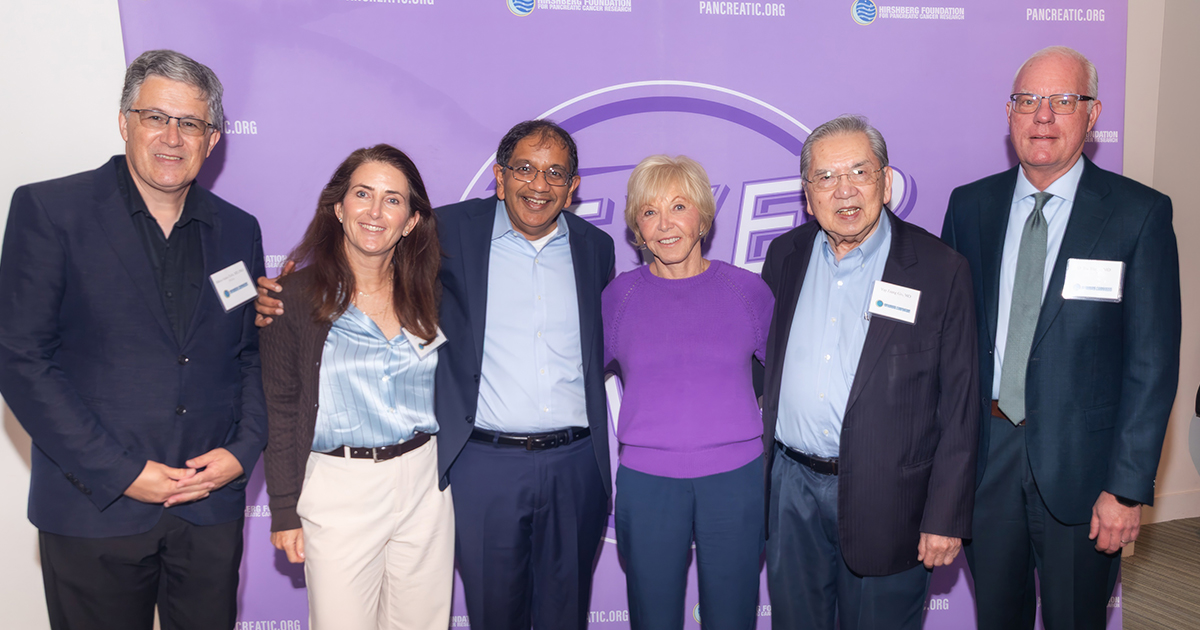
On Friday, October 9th 2026, the Hirshberg Foundation-UCLA Research Forum on Pancreatic Cancer brought together members of the foundation’s Scientific Advisory Board, past Seed Grant recipients, and members of the UCLA pancreatic cancer community for an exciting day of scientific discussion and collaboration. The morning was kicked off with welcoming remarks from Miklos Sahin-Toth, MD, PhD, the current Chair of the Hirshberg Scientific Advisory Board, Lisa Manheim, the Executive Director of the Hirshberg Foundation, and Mark Girgis MD, the recently appointed Director of the UCLA Agi Hirshberg Center for Pancreatic Diseases.
The day was full of engaging talks from previous Seed Grant recipients who provided updates on their Hirshberg-funded research projects. A specific highlight was the Vay Liang Go Endowed Lectureship keynote. Established in 2025, this lecture honors the contributions of Vay Liang Go, MD, to the Hirshberg Foundation and to the greater pancreatic cancer community.
This year’s keynote speaker was Anirban Maitra MD, Professor, Department of Medicine at NYU Grossman School of Medicine, newly appointed Director of the Laura and Isaac Perlmutter Cancer Center, and a member of the Hirshberg Foundation Scientific Advisory Board. For over 20 years, Dr. Maitra’s lab has focused on researching pancreatic cancer with a clear goal of translating his lab’s findings into advances to improve patient outcomes through early detection, therapeutic strategies, and, more recently, cancer interception.
Dr. Maitra’s presentation “Mediators of Restraint in Early Pancreatic Neoplasia” focused on his lab’s efforts to identify the mechanisms that prevent precancerous lesions in the pancreas from developing into pancreatic ductal adenocarcinoma or PDAC. Identification and understanding of these pathways may allow researchers to design therapeutic interventions to help prevent pancreatic cancer from developing in some patients, a type of therapy called interception.
Most PDACs develop out of microscopic lesions called pancreatic intraepithelial neoplasia or PanINs while a smaller proportion develop from pancreatic cysts, generally intraductal papillary mucinous neoplasms or IPMNs. Once thought rare, it is now known that these types of lesions are common and found in many healthy people with a majority of them never developing into PDAC. Dr. Maitra outlined three different mechanisms that are involved in the transition of these precancerous lesions into cancer.
- Most PanINs, like PDAC tumors, harbor mutated KRAS proteins. There are multiple versions of mutant KRAS protein (G12D or G12V for example) and Dr. Maitra and others have found that the different versions of mutant KRAS have different abilities to support the progression of PanINs into PDAC
- In preclinical models, PanINs with a low number of epithelial cells in their microenvironment had high expression of viral-like protein repeats that are typically silenced in human cells. This led to immune cell infiltration into the microenvironment and an increase in inflammation. While these models tended to have more PanINs there was not an increase in PDAC tumors suggesting that the immune system activation and inflammation can help restrain PDAC development.
- Dr. Maitra’s lab identified a protein called NKX6-2 that is expressed in low-grade cysts but not in high-grade cysts. When NKXS6-2 was put back into preclinical models that lacked NKX6-2 expression, these cells developed into low-grade cysts instead of PDAC tumors, suggesting pathways can be therapeutically modified to restrain PDAC development in patients with identified IPMN cysts.
Understanding the mechanisms that restrain PDAC development from precancerous lesions allows for the potential to intervene therapeutically to stop pancreatic cancer from developing at all. This ability could allow people identified as having a high-risk for developing PDAC, because of inherited genetic mutations, family history, or discovery of a pancreatic cysts, an active process of intervention or interception instead of the current protocol of surveillance. In July, a phase 1 trial evaluating a mutant KRAS directed vaccine in high-risk patients had promising early results and more clinical trials evaluating RAS/KRAS targeted therapy are in development to evaluate the prospect of interception in high-risk individuals.
Dr. Maitra’s keynote lecture highlighted his dedication to early detection and intervention in the pursuit of improving outcomes for patients with pancreatic cancer and underscores why his work has been widely influential in the pancreatic cancer field for over 20 years. Dr. Maitra is not only dedicated to his research and training the next-generation of scientist, he is also a generous collaborator to his colleagues highlighting the teamwork necessary to drive meaningful advances in pancreatic cancer care. The Hirshberg Foundation was proud to invite Dr. Anirban Maitra to give the Vay Liang Go Endowed Lectureship at the 2026 Hirshberg Foundation-UCLA Research Forum on Pancreatic Cancer.

