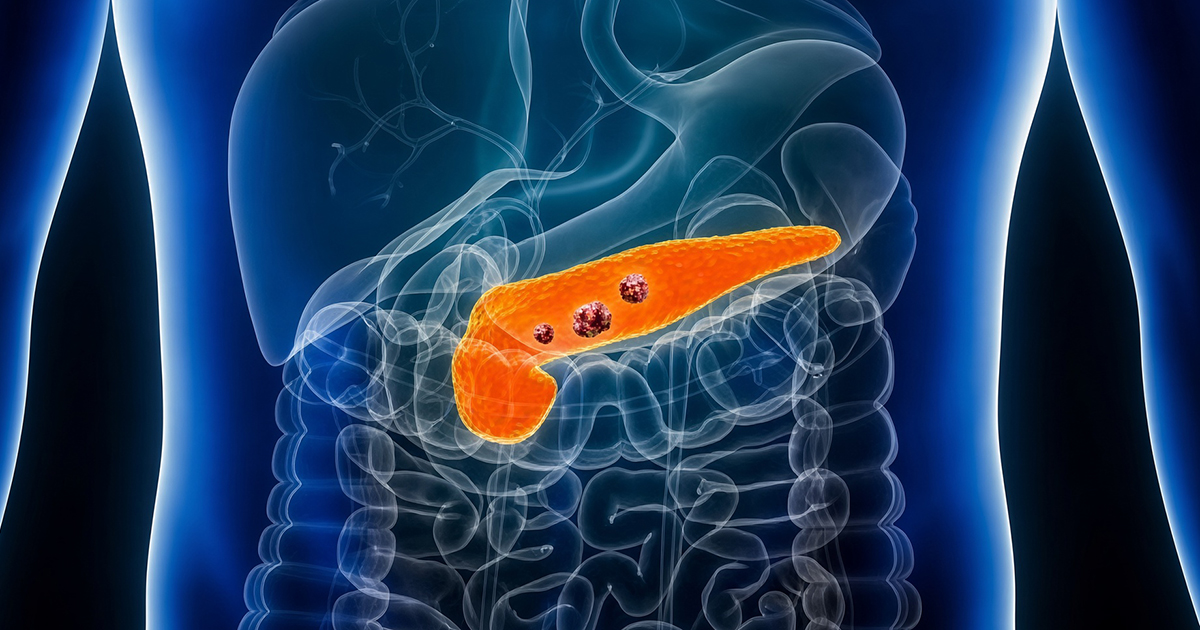
For many people, a pancreatic cyst is a scary diagnosis, but these cysts are surprisingly common. It is important to remember that most pancreatic cysts are not cancerous and will not become pancreatic cancer. However, because some rare pancreatic cancers can have cystic components and certain types of cysts can develop into pancreatic cancer, it is vital that an accurate diagnosis be made and proper follow-up care be received.
Pancreatic cysts are fluid-filled sacs found in or on the pancreas. Most pancreatic cysts don’t cause symptoms and are found during imaging tests such as CT scans or MRIs for other medical reasons. While most pancreatic cysts will not develop into pancreatic cancer, there are important questions to ask your doctor to ensure the proper diagnosis and follow-up care. This article highlights the most common types of pancreatic cysts and outlines how they are diagnosed, managed, and treated, if necessary.
Important questions following a pancreatic cyst discovery
When diagnosed with a pancreatic cyst, the first step is to work with your doctor to determine the type of cyst you have, whether it has any high-risk features, and the best path forward.
Here is a list of questions to start that conversation:
- Do you know what type of cyst I have, or are more tests needed to diagnose it? What additional tests are necessary?
- How large is the cyst, and where is it located?
- Do I have more than one cyst?
- What is my risk level of this being precancerous?
- Should I be monitored? If so, by which test and for how long?
- Are there indications that I may need resection instead of monitoring?
- Does my family history, genetics, or history of pancreatitis affect my risk profile?
- What symptoms should I report right away?
- Do I need to see a specialist for follow-up care?
Types of Pancreatic Cysts
There are multiple types of pancreatic cysts commonly found in the pancreas, each with a different risk of developing into pancreatic cancer. These are four of the most common types of pancreatic cysts.
Pseudocyst
- Most common type of cystic lesion found in the pancreas
- Associated with pancreatitis and inflammation
- Benign, with no potential to develop into pancreatic cancer
- May resolve on their own or be treated to manage symptoms
Serous Cystadenoma or SCA (also called serous cystic neoplasm or SCN):
- Slow growing with multiple small cystic pockets
- Overwhelmingly benign, with a very low risk of developing cancer
- May be monitored, or large cysts causing symptoms may be removed
Mucinous Cystic Neoplasm or MCN (also called mucinous cystadenoma or MCA):
- Primarily occur in women
- Commonly found in the tail of the pancreas and do not involve the pancreatic duct
- Can develop into cancer
- Often resected regardless of size
Intraductal Papillary Mucinous Neoplasm or IPMN
- The most common type of mucinous cyst
- Affects both men and women
- Arise from duct cells and produce mucin that can block ducts
- Three types of IPMNs, depending on cyst location (see below)
- All three types can develop into cancer, and the risk of developing cancer differs for each type.
Main-Duct IPMN (MD-IPMN)
- Located in the main pancreatic duct
- Can present as widening of the main pancreatic duct rather than an obvious cyst
- Highest risk of developing cancer
Branch-Duct IPMN (BD-IPMN)
- Located in ducts branching off the main pancreatic duct
- Predominantly found in the head of the pancreas
- Can be a single cyst or have multiple cystic components
- Lower risk of developing cancer than in main-duct IPMNs
Mixed-Type IPMN (MT-IPMN)
- Involvement of both main pancreatic duct and branch ducts
- Similar risk of developing cancer to MD-IPMN
How is risk assessed for developing pancreatic cancer?
When a pancreatic cyst is identified, the size and type of the cyst, its location, and whether the main pancreatic duct is involved help characterize the level of risk for pancreatic cancer. Pseudocysts carry no risk of developing into pancreatic cancer, and SCAs carry an extremely low risk.
For MCNs and IPMNs, the following factors may suggest a higher-risk cyst:
- Cysts larger than 3 cm in diameter
- Features such as thickened walls, solid components within the cyst, and lumps within the cyst called mural nodules
- Main pancreatic duct involvement or dilation
- Presence of symptoms such as weight loss, abdominal pain, jaundice, or pancreatitis
- Family history of pancreatic cancer or germline genetic mutation associated with pancreatic cancer
Tests such as Magnetic Resonance Cholangiopancreatography (MRCP, a specialized MRI that provides more detailed images of the pancreas, liver, spleen, and gallbladder) and endoscopic ultrasound (EUS) with fluid or tissue sampling can provide additional information to characterize cysts and help determine whether surveillance or treatment is the best path forward.
Cyst Management
While most pseudocysts don’t generally need follow-up or monitoring unless they are causing symptoms, other types of pancreatic cysts can be managed with follow-up and imaging, a process called surveillance. Since pancreatic cysts tend to grow slowly, imaging on a regular basis is sufficient to detect any changes that would suggest to a clinician that treatment was necessary.
Surveillance: Cysts without high-risk features can be monitored with imaging, typically with MRCP or MRI on a yearly basis. For some people with stable cysts that have not changed during monitoring, surveillance may be stopped and only resumed if any symptoms develop.
Enhanced Surveillance: For people with a family history of pancreatic cancer, genetic mutations that increase pancreatic cancer risk, or larger cysts, an enhanced surveillance protocol may be followed. This can include alternating MRCP/MRI and EUS on a yearly or more frequent basis. Biomarkers for pancreatic cancer, such as CA19-9 and glycated hemoglobin (HbA1c), may be monitored as well.
Removal: When a cyst is large, causing symptoms, or has many high-risk features, removal may be the best option for both symptom relief and reducing the risk of developing pancreatic cancer. While surgery is one potential method to remove cysts, there are also less invasive techniques that are being used. The choice of treatment depends on the type, size, and location of the cyst, as well as the medical center handling care.
- Endoscopic approaches to cyst management: While not standard practice, endoscopic techniques are being developed, and their use has expanded to the treatment of pancreatic cysts. These techniques include using alcohol, chemotherapy, or radiofrequency to destroy the cyst.
- Surgical approaches to cyst management: For large cysts or those with multiple high-risk features, surgical resection may be the best option. Techniques for removing part of the pancreas are selected based on the lesion’s location. Minimally invasive techniques, such as robot- or laparoscopic-assisted pancreatic resection, are increasingly used to reduce incision size, blood loss, and recovery time associated with pancreatic surgery.
Ultimately, the decision to undergo surveillance or treatment is based on the patient’s symptoms, the size, behavior, and location of the cyst, and the patient’s family history. Different medical centers may have different protocols for treating pancreatic cysts, and obtaining a second opinion is always a great option to make sure you are comfortable with your diagnosis and treatment plan.
Conclusion
Most people diagnosed with a pancreatic cyst will undergo surveillance to monitor whether their cyst(s) change size or develop features indicating transformation into cancer. A majority of these people will have stable cysts and will not need any further treatment. There is currently a gap in understanding how to precisely identify which patients with mucinous cysts are at the highest risk for progression into pancreatic cancer. Because of that gap, it’s important to watch all patients to catch progression at an early stage for the best outcomes. One key focus of research in this field is to identify biomarkers that will allow clinicians to better stratify a patient’s risk of developing pancreatic cancer. This ability will limit unnecessary follow-up and anxiety for the lowest-risk patients and is an active area of research funded by the Hirshberg Foundation through the Foundation Seed Grant Program.

