Revolution Medicines announced exciting results on three clinical trials evaluating daraxonrasib, their oral RAS inhibitor, that have the potential to transform treatment options for patients with metastatic pancreatic ductal adenocarcinoma (PDAC). PDAC is the most common type of pancreatic cancer, with a 5-year survival rate of 13%. One reason for this low survival rate is that the majority of patients are diagnosed with advanced, metastatic disease with few treatment options currently available. New treatments with better outcomes for this patient population have the potential to be transformative.
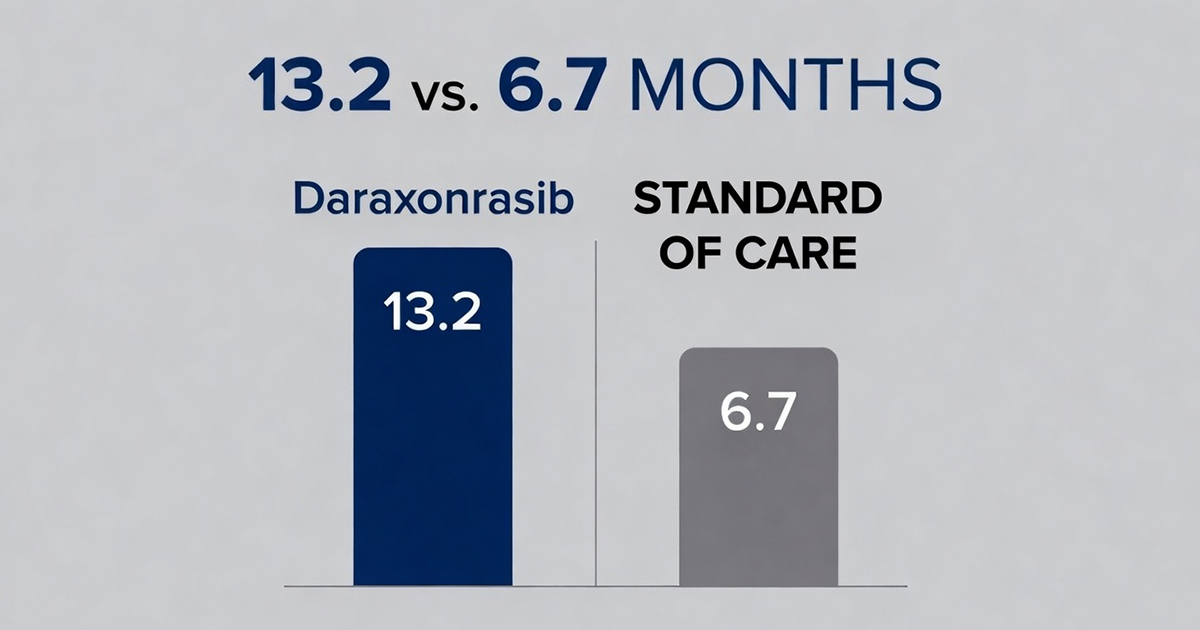
On April 13th, 2026, they shared results from their Phase 3 clinical trial, RASolute 302, demonstrating an unprecedented survival benefit for patients with metastatic PDAC that had previously been treated with chemotherapy. Overall survival (OS) nearly doubled for patients treated with daraxonrasib to 13.2 months compared with 6.7 months for standard-of-care chemotherapy. These data will be presented at the 2026 American Society of Clinical Oncology (ASCO) Annual Meeting in June 2026 and will be submitted to the FDA. Approval of daraxonrasib will be a much-needed new treatment for patients with metastatic PDAC who have failed standard chemotherapy and will improve care for patients with this devastating disease.
Results from two additional trials were shared April 21, 2026, at the American Association for Cancer Research (AACR) Annual Meeting. In a presentation in the Minisymposium: Late Breaking Research Session, Dr. Brian Wolpin, MD, MPH, Director of the Hale Family Center for Pancreatic Research at Dana Farber Cancer Institute, shared results from their ongoing Phase 1/2 clinical trial, RMC-GI-102. Patients with newly diagnosed metastatic PDAC were treated with a combination of daraxonrasib with the chemotherapies gemcitabine and nab-paclitaxel. Antitumor activity was demonstrated with 90% of patients showing either stable disease or tumor regression. Additionally, tumor reduction was seen in 58% of patients with 1 complete response. Importantly, the safety profile was similar to that of each therapy by itself. At 6 months, the progression free survival (PFS) was 84% and OS was 90%.
Preliminary data from RMC-6236-001, a Phase 1/2 clinical trial was also presented. This trial is investigating daraxonrasib as a stand-alone treatment for previously untreated patients with metastatic PDAC. While still early, the disease control rate (DCR) is 92% with an overall response rate of (ORR) of 47% with 1 patient having a complete response. The data from both trials support the recently initiated Phase 3 clinical trial, RASolute 303, evaluating daraxonrasib, alone or in combination with chemotherapy, in newly diagnosed metastatic PDAC patients.
What is daraxonrasib?
Daraxonrasib is a RAS inhibitor; it binds RAS protein to block its function. RAS has 3 forms: KRAS, NRAS, and HRAS that control cell proliferation and survival. KRASis one of the most frequently mutated genes to cause cancer (see KRAS overview); mutated KRAS is found in more than 90% of PDAC tumors making it an appealing therapeutic target.
Daraxonrasib is a type of drug called a molecular glue; it binds the active form of RAS protein as well as a protein called Cyclophilin A to generate an inactive protein complex. While other RAS inhibitors are specific to the KRAS form of the protein or to specific mutations found in KRAS, daraxonrasib can bind all active forms of RAS, regardless of mutations present, and because of this ability has the potential to treat a range of tumor types outside of PDAC.
Glossary:
Overall survival (OS): The length of time from treatment initiation that a patient remains alive. Considered the gold standard for clinical trial endpoints.
Progression-free survival (PFS): The length of time from treatment initiation to when disease progresses. Usually using the RECIST 1.1 criteria for increase in tumor size around 20%. Commonly used as a primary end point in clinical trials
RECIST 1.1 Criteria: A standardized method for determining disease progression or response in a clinical trial. Tumor size is measured by imaging at the start and then repeated over the course of treatment.
Complete response (CR): All visible signs of cancer have disappeared due to treatment., frequently measured by imaging.
Partial response (PR): Tumor size has decreased at least 30% from the initial tumor size but have not completely regressed due to treatment.
Stable disease (SD): When tumors haven’t increased or decreased in size more than 20% of initial tumor size.
Disease control rate (DCR): The percentage of patients who have stable disease, partial response, or complete response due to treatment.
Overall response rate (ORR): The percentage of patients who have a response (CR or PR) to treatment based on the RECIST 1.1 criteria. Unlike disease control rate, it does not include patients with stable disease.

