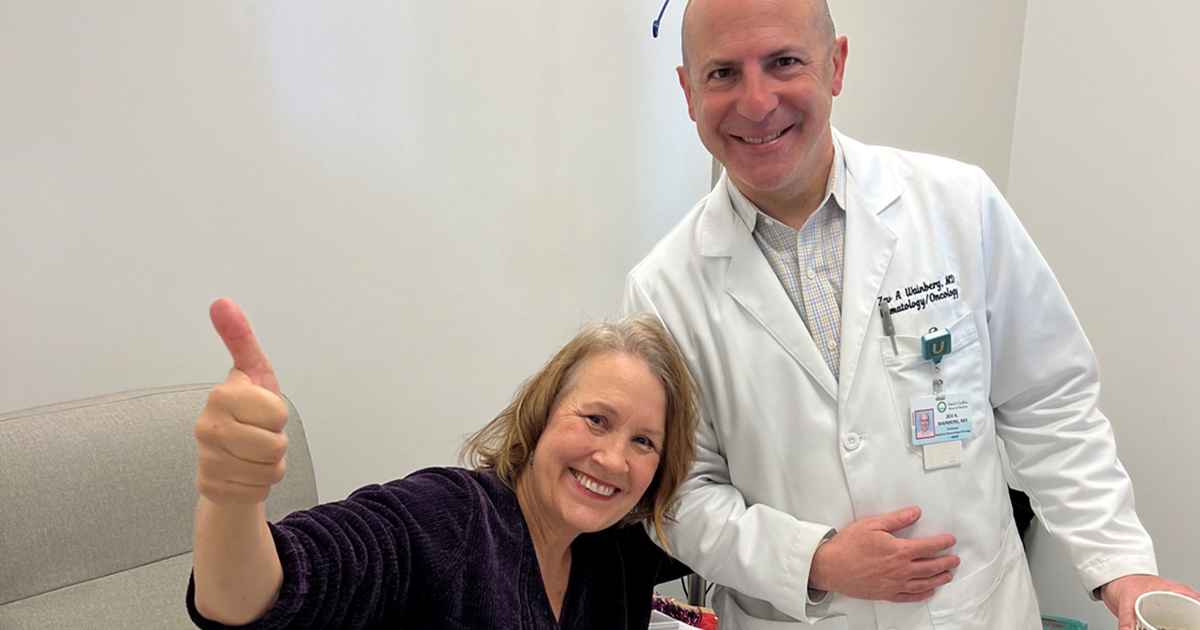
Jeanette Reedy Solano has been part of the Hirshberg Foundation throughout her cancer journey. As a member of Tom’s pancreatic cancer patient support group, she has joined us at the Symposium, Casual Sunday, and other events throughout the year.
At the 20th Annual Symposium, Jeanette shared twelve lessons she’s learned through diagnosis, treatment, and recovery. She was also recently featured in a UCLA Health article about her treatment and participation in a clinical trial at UCLA.
The principal investigators on the trial are Timothy Donahue, MD and Zev Wainberg, MD, along with Jason Link, PhD, an associate adjunct professor of surgery, all members of the UCLA Health Jonsson Comprehensive Cancer Center (JCCC), where the trial is being conducted and deeply connected to the Hirshberg Foundation.
Jeanette, a Glendale resident and professor of religious studies at Cal State Fullerton, underwent a 10-month odyssey before getting diagnosed with pancreatic cancer in the summer of 2024. She traveled to Johns Hopkins where she was told her cancer was stage 3 and wrapped around vital veins and arteries. The oncologist she spoke with said only a lucky few in her condition made it to surgery.
“There haven’t been too many effective treatments in the past, but that might be changing somewhat now,” Dr. Donahue said in the article. “These tumors have been resistant to most chemotherapies, targeted therapies, immunotherapies, you name it. It’s why we need research.”
Jeanette recalled, “I had just gotten this terrible prognosis and I’m reeling from it. That night I had a video consult with Dr. Donahue and he’s looking at my scans, and he says, ‘I think you are actually borderline resectable and might be eligible for a trial.’ That gave me so much hope.”
In cases where essential blood vessels are involved, the standard of care is to attempt to shrink the tumor with chemotherapy so that the patient is eligible for surgery with less risk of dangerous bleeding.
“For borderline resectable, you can’t take it out right away, but you could if you have a good response to chemo,” Dr. Wainberg said in the article. “We were asking what if we give them chemo plus these two immunotherapies, can we do even better than chemo alone?” This thinking led to a unique clinical trial conceived of and sponsored by UCLA Health rather than a drug company. The team then secured funding from the National Institutes of Health and Department of Defense.
Jeanette liked the idea of how the immunotherapies worked together. She received standard-of-care chemotherapy coupled with two experimental immunotherapy drugs to help enlist her immune system to fight the cancer.
“It’s basically like a defense and offense combination,” she said in the article. “I thought it was novel and unique, and I was really lucky to be included.”
The immunotherapies, which have not been approved by the Food and Drug Administration, work to ramp up the immune system in different ways. Zimberelimab, a checkpoint inhibitor, stops cancer cells from deactivating T cells, allowing them to attack the cancer. Quemliclustat acts as a blocker for adenosine, a chemical that is enhanced in people with pancreatic cancer and can diminish the immune system’s response.
In addition to the trial, she received support services from the Simms/Mann UCLA Center for Integrative Oncology.
“It’s not just wonderful surgeons like Dr. Donahue and scientists like Dr. Wainberg, it’s the whole package you get at UCLA, helping you navigate a life-changing diagnosis,” she said. “UCLA does a really good job of understanding all the elements of a cancer diagnosis, integrating psycho-social and even spiritual support during those first few months when you are shattered.”
After her 11 sessions of infusions ended in February 2025, she was ready for surgery. By March 2025, her tumor had gone from 4.2 to 0.33 centimeters. She returned to UCLA for an 8 ½-hour surgery to remove her tumor. The surgery resulted in a total pancreatectomy, the removal of her gallbladder, spleen, bile duct and part of her small intestine, due to the blood vessels involved and the location of the tumor. Without a pancreas to produce insulin, she is now diabetic, which is very challenging.
Dr. Donahue said that when a pathologist looked at Jeanette’s tumor under a microscope, very few tumor cells were still present. This is known as a major histopathologic response, indicating that pre-surgical treatment destroyed almost all the tumor.
“It’s an incredible outcome,” Dr. Donahue said. “With chemotherapy alone, without this combination, we would only see that very rarely. But we’re seeing it more and more with this more effective treatment. I think her prognosis is outstanding.”
Dr. Donahue, professor of surgery at UCLA and surgical director of the UCLA Agi Hirshberg Center for Pancreatic Diseases, noted that more than 90% of the roughly 30 phase 1 trial participants were eligible for surgery, although some have not yet completed the treatment to see if they qualify. Of the patients who have gone to surgery, 43% either had no cancer cells seen under the microscope or very few.
“If you compare that to chemotherapy, that number is just 10%,” Dr. Donahue said. “It looks like there is about a four-fold improvement in the patients that are having a major histopathological response to the treatment.”
Jeanette is now cancer-free and no longer in treatment but does have routine monitoring. She has returned to teaching. She has been traveling the world, including a trip with her husband and daughter to mark one year of being cancer-free.
“We went to Iceland and saw the Northern Lights and sat in the hot springs while reveling in the beautiful world we live in, and celebrated being alive,” she said in the article. Jeanette believes clinical trials for pancreatic cancer are beginning to turn the tide and she encourages other patients she meets through her support groups to enroll. She said, “trials are critical parts of advancing treatment. There are no guarantees, but I know they’re worth it.”
Excerpts from the article referenced originally appeared on the UCLA Health website.

